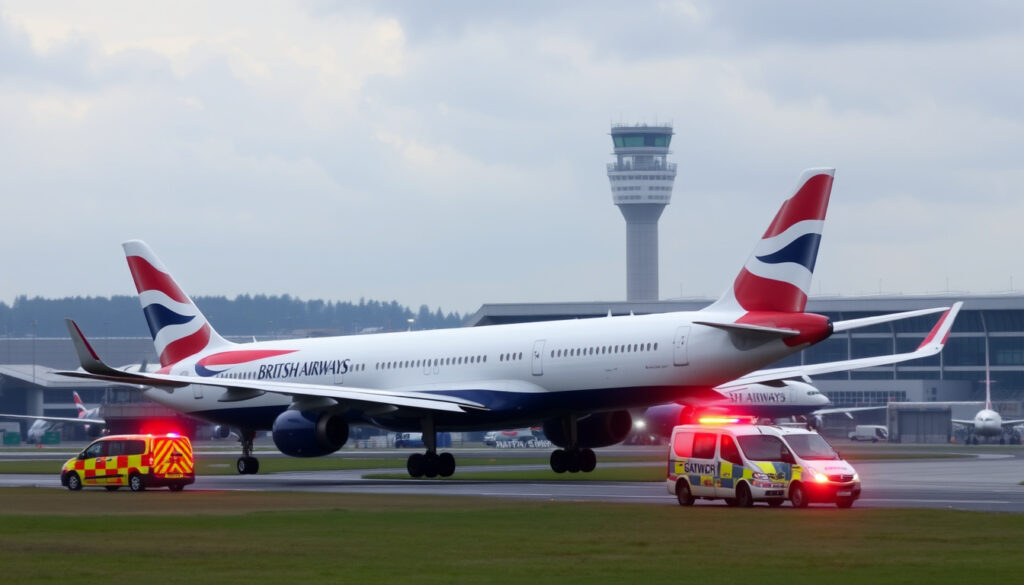
British Airways Emergency Landing Gatwick – BA2615 Timeline and Facts
British Airways flight BA2615 declared an emergency and safely returned to London Gatwick Airport on July 31, 2025, after experiencing issues during its approach. The Airbus A321, operating a route from Luqa in Malta, triggered the universal emergency code squawk 7700 while in holding patterns before landing.
The aircraft, registered as G-EUXI, touched down on runway 26L and was met by fire-fighting crews as it taxied to its stand. All passengers disembarked normally, with no reported injuries from the incident. The emergency declaration comes amid heightened attention on aviation procedures following several notable incidents at major UK airports this year.
What Happened with the British Airways Emergency Landing at Gatwick Today?
Flight BA2615 departed Luqa Airport in Malta and was operating its scheduled service toward London Gatwick when the crew initiated an emergency declaration. The decision to return came after an extended holding pattern, during which the aircraft circled before its intended approach. Pilots broadcast the distress code 7700—the international transponder signal indicating a general aviation emergency—requesting priority handling from air traffic control.
The code 7700 triggers immediate coordination between the aircraft, air traffic control, and airport emergency services. Fire crews are positioned along the runway as a precautionary measure regardless of the specific nature of the emergency.
BA2615
Airbus A321 (G-EUXI)
Luqa to Gatwick
Emergency declared, safe landing completed
Airport fire crews responded to the runway as the aircraft completed its final approach, a standard procedure when a distress code is active. The aircraft landed without incident and was escorted by emergency vehicles as it taxied to its gate position. Passengers disembarked through the standard jet bridge procedure, with airport staff coordinating the arrival.
Key observations from the incident include the rapid coordination between the flight crew, air traffic controllers, and ground emergency services. The aircraft maintained communication throughout the approach, allowing controllers to clear other traffic and prepare the runway for priority landing. No operational disruptions to other flights at Gatwick were reported as a direct consequence of the emergency landing.
Confirmed Details of the BA2615 Emergency
- Emergency transponder code 7700 activated during holding pattern
- Priority landing clearance granted by air traffic control
- Fire service positioned along runway 26L as precaution
- Aircraft taxied to stand 33 under escort
- All passengers safely disembarked
- No injuries reported during the incident
- No confirmed impact on other Gatwick operations
| Fact | Details |
|---|---|
| Flight Number | BA2615 |
| Aircraft Type | Airbus A321 |
| Registration | G-EUXI |
| Origin | Luqa Airport, Malta |
| Destination | London Gatwick |
| Runway Used | 26L |
| Gate Position | Stand 33 |
| Injuries | None reported |
Details on British Airways Flight BA2615 Emergency Declaration
The crew aboard BA2615 initiated the emergency declaration while the aircraft was in a prolonged holding pattern. Holding patterns occur when air traffic control directs pilots to circle in a designated airspace, typically due to congestion, weather, or runway unavailability. The decision to declare an emergency during this phase suggests the crew identified a condition requiring immediate landing clearance.
According to flight tracking data from FlightAware, the aircraft had been scheduled to land at 15:07 BST but experienced significant delays during its descent. The actual landing occurred at 16:07 BST, representing a one-hour deviation from the planned arrival time. This delay was attributed to the extended holding and subsequent emergency handling procedures.
Understanding the Squawk 7700 Code
Pilots transmit the four-digit transponder code 7700 to indicate a general emergency situation. Unlike more specific codes—such as 7600 for radio failure or 7500 for unlawful interference—code 7700 signals that the aircraft requires priority handling without specifying the exact nature of the problem. Air traffic controllers receiving this signal immediately notify relevant emergency services and clear airspace and runways as needed.
When an aircraft transmits 7700, controllers typically coordinate an immediate approach clearance while alerting crash and rescue firefighting services. The aircraft is often vectored directly to the nearest suitable runway regardless of other traffic.
The specific cause behind the emergency declaration on BA2615 remains undisclosed in available reports. Aviation sources indicate that crews may declare emergencies for various reasons, including medical situations aboard, mechanical concerns, fuel emergencies, or operational issues requiring urgent attention. Without an official statement from British Airways or the relevant aviation authority, determining the precise trigger for the declaration is not possible.
Emergency Response Protocol at Gatwick
London Gatwick maintains comprehensive emergency response capabilities consistent with its status as one of the United Kingdom’s busiest airports. When an aircraft declares an emergency, airport fire services position vehicles along the anticipated landing runway and prepare for immediate deployment if required. The escort observed following BA2615’s landing is standard practice to ensure the aircraft reaches its gate safely while emergency crews remain ready.
The airport’s coordination with air traffic control ensures the runway remains clear and other aircraft are either held or redirected as necessary. This protocol minimizes risk to the emergency aircraft and maintains overall airport safety during high-priority operations.
Video and Live Updates on Gatwick Emergency Landing
Several media outlets have published footage capturing elements of the BA2615 emergency response. Live video recordings showing the aircraft on approach and during its emergency handling have appeared across social media platforms, generating significant public interest in the incident.
Aviation-focused channels have produced additional coverage, including short-form updates summarizing the incident for viewers following developments in real-time. These resources provide visual documentation of the emergency response sequence, from the aircraft’s initial approach through its safe arrival at the terminal.
Media Coverage and Source Verification
Coverage from outlets including Air Live and Dailymotion has contributed to public understanding of the sequence of events. However, it is important to note that much of the available information originates from unofficial sources, including social media posts and aviation hobbyist feeds. Independent verification from British Airways, Gatwick Airport Authority, or aviation regulators has not been publicly confirmed at this time.
Published timelines and details may vary between sources. Some videos referenced in coverage discuss separate or unrelated Gatwick incidents, highlighting the importance of verifying claims against primary sources before drawing conclusions.
Updates beyond the initial landing have not been widely reported. Search results and news aggregators show no subsequent announcements regarding passenger welfare, aircraft inspection findings, or regulatory involvement. This does not indicate any concern but rather reflects the current limits of publicly available information.
British Airways Flights and Gatwick Operations Impact
British Airways maintains a significant presence at London Gatwick, operating both domestic and European services from the airport. The incident with BA2615 occurred within a broader context of varied aviation activity at the airport, including previous emergencies and operational disruptions that have drawn public attention to air travel safety protocols.
Unlike the London Heathrow Airport Fire that caused substantial operational chaos earlier this year, the BA2615 emergency did not appear to trigger significant broader disruptions at Gatwick. No reports indicate runway closures extending beyond the immediate landing sequence, and other scheduled services continued relatively normally following the incident.
Passenger Information and Rights
Passengers aboard BA2615 experienced an altered arrival procedure compared to their scheduled itinerary. While no injuries were reported, passengers may be entitled to certain assistance under UK and EU aviation regulations depending on the specific circumstances and cause of the emergency. Travel rights and passenger protections remain relevant considerations for those affected by unexpected flight irregularities.
British Airways has not issued a public statement regarding the incident as of the latest available reports. Passengers seeking information about rebooking options or compensation would typically need to contact the airline directly through official customer service channels.
Timeline of the BA2615 Emergency Landing
The following sequence reconstructs the main events of the BA2615 emergency based on available flight tracking and media reports. All times are provided in British Summer Time.
- Pre-landing phase: The crew declared an emergency while the aircraft was in a holding pattern during its approach to Gatwick.
- 15:56 BST: BA2615 touched down on runway 26L at London Gatwick Airport.
- 15:58 BST: The aircraft began taxiing toward its gate, escorted by airport fire trucks.
- 16:05 BST: The aircraft arrived at stand 33, completing its ground movement under escort.
- Gate arrival: Flight tracking data confirms final arrival at the gate at approximately 16:11 BST.
The scheduled arrival time for the flight was 15:07 BST, meaning the aircraft landed approximately one hour behind schedule. This delay incorporates both the extended holding pattern before approach and the additional time required for emergency coordination and priority landing clearance.
What We Know and What Remains Unclear
The available information surrounding the BA2615 emergency provides a clear account of the aircraft’s movements and the outcome of the incident. However, several aspects remain incompletely documented in public sources.
Established Information
- Flight BA2615 declared emergency code 7700
- Aircraft landed safely on runway 26L
- Fire crews responded and escorted the aircraft
- All passengers disembarked safely
- No injuries were reported
- The aircraft arrived at stand 33
Unconfirmed Details
- Specific cause of the emergency declaration
- Whether the situation was precautionary or related to a technical issue
- British Airways’ official assessment of the incident
- Gatwick Airport Authority’s response or investigation
- Regulatory involvement or mandatory reporting outcomes
- Impact on subsequent flight operations
Without official statements from British Airways, Gatwick Airport, air traffic control authorities, or aviation regulators, attributing the emergency declaration to any specific cause would require speculation. Aviation professionals note that emergency codes may be activated for a wide range of reasons, from precautionary responses to genuine mechanical concerns, and that pilots are trained to err on the side of caution.
Aviation Emergency Procedures: Broader Context
Emergency declarations by commercial aircraft, while uncommon, represent a standard feature of aviation safety protocols. Pilots are authorized and encouraged to declare emergencies whenever any condition exists that may compromise the safety of the flight, crew, or passengers. This conservative approach ensures that potential issues are addressed before they escalate.
The aviation industry maintains rigorous standards for emergency response, with coordinated procedures between flight crews, air traffic control, and airport services. These protocols are regularly reviewed and updated following incidents to incorporate lessons learned and improve overall safety margins.
For passengers, understanding these procedures provides reassurance that multiple layers of protection exist throughout the flight experience. The response to the BA2615 incident demonstrates how quickly coordinated action can occur when an emergency is declared, prioritizing safety above schedule or convenience.
Sources and Official Documentation
Primary sources for this incident include aviation tracking platforms and live media feeds. Air Live provided detailed timeline information, while FlightAware contributed flight tracking data confirming the scheduled versus actual arrival times. Video documentation from YouTube and Dailymotion supplemented the textual records with visual coverage of the incident.
The emergency declaration occurred after a long holding pattern on approach, with the crew maintaining communication throughout the incident response sequence.
— Air Live incident report, July 31, 2025
Notably absent from the available sources are direct statements from British Airways, the Civil Aviation Authority, or Gatwick Airport Limited. Aviation industry standards typically require operators to file reports following emergency declarations, and such documentation may become publicly available through regulatory channels in the coming weeks or months.
Summary
British Airways flight BA2615 returned safely to London Gatwick Airport on July 31, 2025, after the crew declared an emergency during a holding pattern before approach. The Airbus A321, operating the route from Luqa, Malta, landed on runway 26L and was met by emergency services before taxiing to stand 33 under escort. All passengers disembarked without reported injury.
The specific cause of the emergency declaration remains undisclosed in available public sources. Neither British Airways nor Gatwick Airport Authority has issued official statements regarding the incident. Flight tracking data confirms a landing time of approximately one hour behind schedule, with the delay attributed to the holding pattern and priority landing procedures. Passengers seeking further information should monitor official airline communications for updates as more details may emerge through regulatory reporting channels.
Frequently Asked Questions
What flight declared an emergency at Gatwick today?
British Airways flight BA2615 declared an emergency on July 31, 2025, while approaching London Gatwick Airport. The aircraft, an Airbus A321 registered G-EUXI, was operating from Luqa, Malta.
What does declaring a squawk 7700 mean?
The transponder code 7700 indicates a general aviation emergency. When pilots transmit this code, air traffic controllers immediately coordinate priority handling and alert emergency services at the destination airport.
Were there any injuries during the BA2615 emergency landing?
No injuries have been reported in connection with the BA2615 emergency. All passengers disembarked normally following the aircraft’s safe landing on runway 26L at Gatwick.
What caused the British Airways emergency at Gatwick?
The specific cause of the emergency declaration has not been publicly confirmed. Available reports indicate the emergency occurred during a prolonged holding pattern before approach, but British Airways and relevant authorities have not issued official statements attributing the incident to any particular cause.
Did the emergency disrupt other flights at Gatwick?
No reports confirm significant operational disruptions to other flights at Gatwick as a direct result of the BA2615 emergency. The aircraft was escorted to its gate following landing, but runway closures appeared limited to the immediate landing sequence.
What was the scheduled arrival time for BA2615?
BA2615 was scheduled to land at approximately 15:07 BST. The actual landing occurred at around 16:07 BST, representing a delay of approximately one hour attributed to the extended holding pattern and emergency handling procedures.
Where can I find video footage of the incident?
Live video footage and updates are available through aviation-focused channels on YouTube and other platforms. Links to footage showing the approach and emergency response have appeared in various media reports documenting the incident.
More related posts
 Keir Starmer Approval Rating – Latest Polls and Trends
 Isle of Man TT 2025 – Complete Schedule and Race Guide
 Cinnamon Roll Hello Kitty – Sanrio Lore and Fan Recipes
 Seven Wonders of the World – History, Locations and Facts
 Swiss Butter – Holborn Menu – Prices, Options and Guide
 Can I Claim Carer’s Allowance For Myself – UK Rules Rates Eligibility
 Nina Drama – Biography, Net Worth, Ethnicity and UFC Career
 How to Transfer Data from iPhone to iPhone – All Official Methods
