Seven Wonders of the World – History, Locations and Facts
The Seven Wonders of the Ancient World
The Mediterranean basin of antiquity hosted architectural feats that dwarfed contemporary structures, setting standards for magnificence that persisted for centuries. These monuments, later cataloged by Hellenistic travelers and poets, became known collectively as the Seven Wonders of the Ancient World. Their collective status emerged not from a single authoritative list, but through the consensus of ancient chroniclers who documented these sites between the fifth and second centuries BCE.
Spanning from modern-day Egypt to Turkey, these marvels represented the technological apex of Greek, Egyptian, and Mesopotamian civilizations. Archaeological evidence suggests that six served religious, funerary, or commemorative functions, while the seventh—the Lighthouse of Alexandria—guided maritime commerce through Egypt’s busiest harbor.
The Complete Catalog
The canonical list comprises: the Great Pyramid of Giza, the Hanging Gardens of Babylon, the Statue of Zeus at Olympia, the Temple of Artemis at Ephesus, the Mausoleum at Halicarnassus, the Colossus of Rhodes, and the Lighthouse of Alexandria. Historical records indicate that all but the Hanging Gardens existed definitively, though the gardens’ location remains archaeologically elusive despite textual references.
Patterns of Monumental Construction
Construction of these monuments occurred across a 2,300-year span, yet they share remarkable similarities. Each utilized locally abundant materials—limestone in Egypt, marble in Greece, stone and bronze in Rhodes—transformed through sophisticated engineering. Structural analyses reveal that architects employed principles of leverage, load distribution, and optical refinement that would not be superseded until the Renaissance.
Geographically, the dispersion reflects the cultural sphere of Greek influence following Alexander’s conquests. Three wonders stood on Greek soil or islands, while those in Egypt and Mesopotamia fell within Hellenized territories. This clustering suggests the list functioned partly as a travel guide for affluent Greek tourists of the classical period.
| Wonder | Location | Construction Date | Date of Destruction | Cause |
|---|---|---|---|---|
| Great Pyramid of Giza | Giza, Egypt | Still standing | — | |
| Hanging Gardens of Babylon | Babylon, Iraq | (disputed) | Unknown | |
| Statue of Zeus at Olympia | Olympia, Greece | Fire/Earthquake | ||
| Temple of Artemis | Ephesus, Turkey | Goths/Arson | ||
| Mausoleum at Halicarnassus | Bodrum, Turkey | Earthquake | ||
| Colossus of Rhodes | Rhodes, Greece | Earthquake | ||
| Lighthouse of Alexandria | Alexandria, Egypt | Earthquake |
Architectural Specifics
The Great Pyramid remains the only largely intact survivor, its 146-meter limestone casing originally gleaming under the Egyptian sun. UNESCO World Heritage records confirm its status as the oldest of the wonders and the only one available for modern visitation. Its construction involved approximately 2.3 million stone blocks, some weighing 80 tons, assembled with such precision that a playing card cannot fit between most joints.
The Colossus of Rhodes, a bronze statue of the sun god Helios, stood roughly 33 meters high—comparable to the Statue of Liberty from heel to crown—yet survived only 54 years before an earthquake toppled it. The Hanging Gardens, allegedly built by Nebuchadnezzar II for his wife Amytis, featured terraced greenery irrigated through an early chain-pump system, though modern excavations have yet to confirm their exact location or even existence.
Chronological Development
The timeline reveals an accelerating pace of monumental construction. The pyramid predates the youngest wonder—the Colossus and Lighthouse—by over two millennia. This compression suggests that by the Hellenistic period, technological capabilities and economic resources had converged to enable rapid, ambitious projects. However, fragility increased alongside scale; the three youngest wonders all succumbed to seismic activity within centuries of completion.
Ancient Versus Contemporary Designations
Modern confusion often conflates these ancient sites with the New Seven Wonders of the World, selected through a 2007 global poll. The original wonders derive exclusively from the Greco-Roman world, excluding equally impressive monuments like the Great Wall of China or Machu Picchu solely due to ancient geographical ignorance. Contemporary archaeology recognizes that numerous non-Mediterranean cultures produced engineering marvels of comparable sophistication during the same eras.
The Engineering Paradox
Analysis of construction methods reveals sophisticated understanding of mathematics and materials. The Mausoleum at Halicarnassus combined Greek, Egyptian, and Lycian architectural styles, creating a visual language that influenced monumental tombs through the nineteenth century. Yet most wonders prioritized aesthetic grandeur over structural resilience. The Temple of Artemis, destroyed and rebuilt three times, demonstrates that ancient architects accepted mortality in their creations, perhaps viewing destruction as an opportunity for renovatio rather than failure.
“I have set eyes on the wall of lofty Babylon on which is a road for chariots, and the statue of Zeus by the Alpheus, and the hanging gardens, and the colossus of the Sun, and the huge labour of the high pyramids, and the vast tomb of Mausolus; but when I saw the house of Artemis that mounted to the clouds, those other marvels lost their brilliancy.”
— Antipater of Sidon,
Herodotus, writing in the fifth century BCE, provided earlier textual verification for several sites, describing the pyramid’s construction methods and the temple’s splendor with the precision of an eyewitness.
The Singular Legacy
Today, only the pyramids at Giza remain substantially intact, their geometric perfection continuing to dominate the desert landscape. The others survive primarily through numismatic evidence, literary description, and scattered archaeological fragments. Their destruction patterns—mostly seismic—highlight the geological volatility of the Mediterranean basin and the limitations of pre-industrial engineering against natural forces.
These monuments established the very concept of a “wonder” as a category of human achievement. Contemporary engineering assessments suggest that replicating these structures today would require substantial investment despite modern technology, testament to the efficiency of ancient methods.
Frequently Asked Questions
Why do only the pyramids remain standing?
The Great Pyramid’s survival stems from its massive scale, stable desert foundation, and relatively simple geometric form. Unlike the other wonders, which featured hollow spaces, cantilevered elements, or bronze components vulnerable to earthquakes and looting, the pyramid’s solid stonework distributed weight evenly across bedrock. Additionally, its remote location discouraged stone quarried for medieval construction projects that consumed the facing stones of other monuments.
Who originally listed these as the Seven Wonders?
No single author created the definitive list. Hecataeus of Miletus and Herodotus provided early descriptions, while Antipater of Sidon’s epigram established the canonical seven around 140 BCE. Philo of Byzantium’s “On The Seven Wonders,” written in the second century BCE, codified the tradition for subsequent generations.
Can tourists visit the sites today?
Only the Great Pyramid complex at Giza remains fully accessible to visitors. The Mausoleum’s foundations are visible in Bodrum, Turkey, while the Temple of Artemis’s single reconstructed column stands in Ephesus. The locations of the Hanging Gardens remain unidentified, and the Colossus, Lighthouse, and Statue of Zeus survive only as archaeological fragments in museums.
What is the difference between Ancient and Modern Seven Wonders?
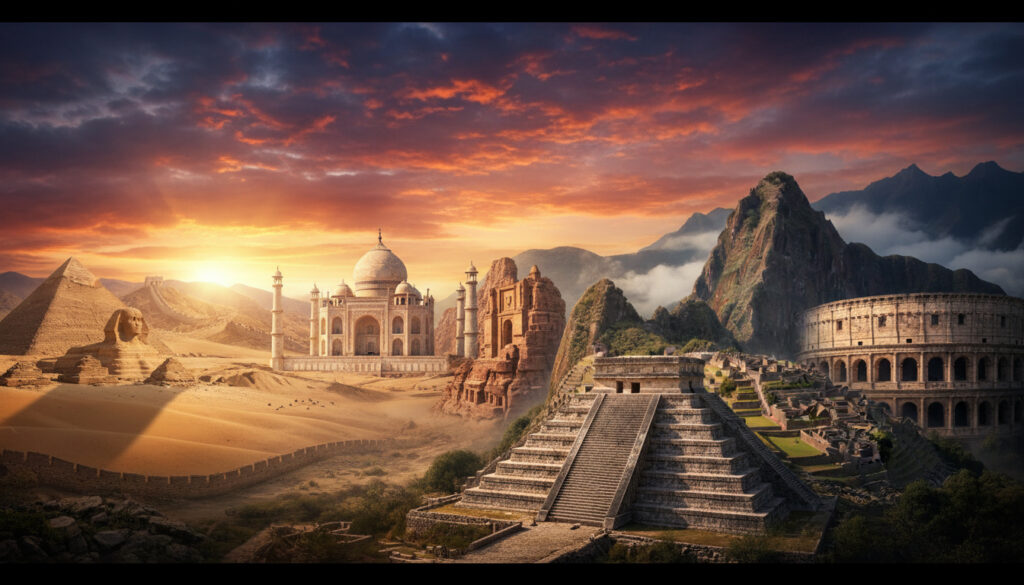
The Ancient Wonders date from the classical Mediterranean world, with the list formalized by Hellenistic writers. The Modern Seven Wonders, selected in 2007 through a global vote organized by the New7Wonders Foundation, include the Great Wall of China, Petra, Christ the Redeemer, Machu Picchu, Chichen Itza, the Colosseum, and the Taj Mahal—representing global heritage beyond the Mediterranean perspective.
How long did it take to build the Great Pyramid?
According to Herodotus and corroborated by modern Egyptology, the Great Pyramid required approximately 20 years to complete, employing seasonal labor crews rather than slaves. Archaeological evidence from workers’ villages suggests organized teams working in rotation during the Nile’s inundation periods when agricultural work paused.
More related posts
 Trevor Noah – Biography, Net Worth, and What He Does in 2025
 Waspi Compensation Latest News Today – Government Rethink and Timeline
 How to Cook Bacon in Air Fryer – Crispy No-Mess Guide
 James Gunn Movies and TV Shows – Complete Filmography List
 Once Upon a Time in America – Everything You Need to Know
 How to Transfer Data from iPhone to iPhone – All Official Methods
 Aaron Taylor Johnson Children – Names Ages and Blended Family Facts
 Night Lark Coverless Duvet – Expert Review & Buyer’s Guide
